


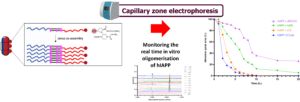
 This study, conducted in collaboration with BioCIS (S. Ongeri), the IMMM (O. Colombani), and IGPS (Myriam Taverna and Claire Smadja), and funded by ANR JAROD, led to the development of Janus polymeric nanorods (JNRs) to inhibit the assembly of amylin (or hIAPP, human islet amyloid polypeptide) into toxic oligomers implicated in type 2 diabetes. Thanks to analytical methods based on capillary electrophoresis developed by team MASTER (IGPS)— which enable real-time monitoring of the in vitro oligomerization of hiAPP and also predict its affinity for an inhibitor immobilized on the JNRs — the ability of functionalized JNRs to prevent the “toxic” oligomerization of hiAPP has been demonstrated.
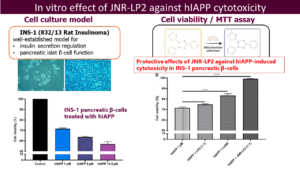
In vitro studies conducted on INS-1 pancreatic β-cells showed that JNRs prevented amylin cytotoxicity induced by oligomerization, while exhibiting good biocompatibility. This discovery, published in Small Science in 2026, opens up promising prospects for a cure for type 2 diabetes, which will be explored in a second ANR project, “Damocles,” set to begin this year.
The article : https://onlinelibrary.wiley.com/doi/10.1002/smsc.70326